Self-Host OneTimeSecret ≠ Zero-Knowledge (Honest 2026 Answer)
TL;DR
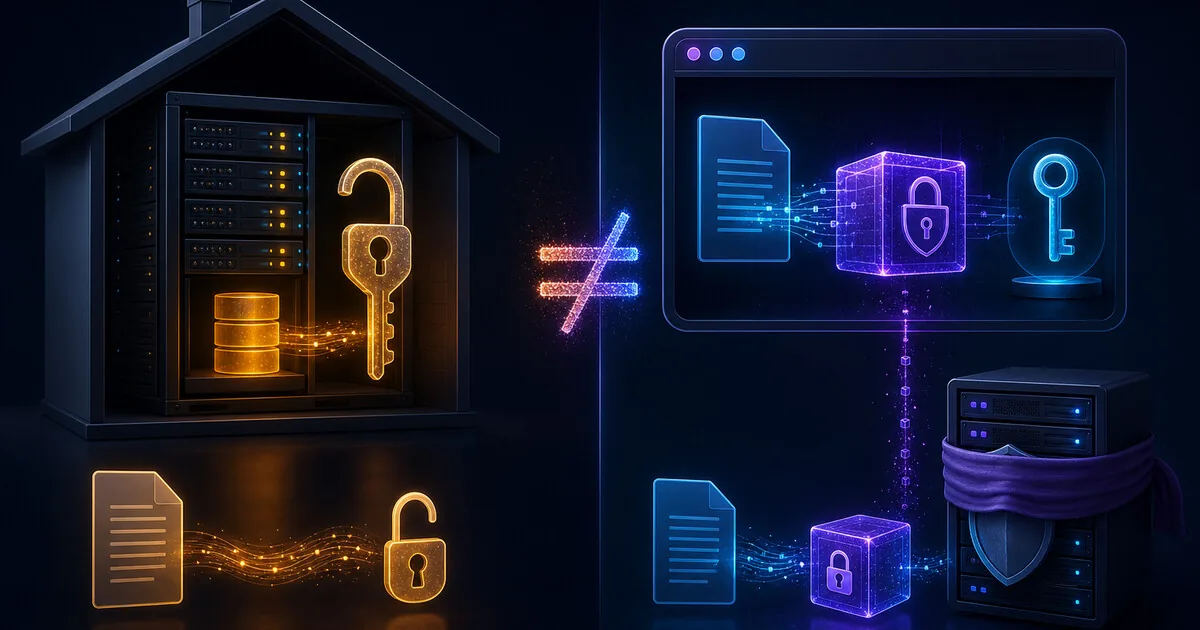
Self-hosting OneTimeSecret does not give you zero-knowledge encryption. It changes who runs the server-side crypto — you instead of onetimesecret.com — but OTS still encrypts and decrypts on the server, so the operator (now you) can read secrets. Zero-knowledge requires client-side encrypt and a key that never hits the server (for example in the URL fragment). Self-host can be fine when you trust your infra; just do not call it ZK. For provider-blind handoffs, use VanishingVault or read our OTS comparison.
Related: VanishingVault vs OneTimeSecret · best one-time secret sharing tools · URL fragment keys explained · why zero-knowledge should be the default.
If I Self-Host OneTimeSecret, Do I Get Zero-Knowledge?
No.This is the quotable answer Reddit threads and internal wikis often get wrong: “just self-host OTS” solves data residency and vendor trust — it does not flip server-side encryption into zero-knowledge.
OneTimeSecret's own documentation describes encryption handled on the server. When someone creates a secret, plaintext transits to (or is processed by) the application, which encrypts with keys the server controls. When someone views it, the server decrypts to serve the page. Self-hosting runs the same Ruby stack on your hardware — so you become the party with plaintext access, not a zero-knowledge courier.
Zero-knowledge secret sharing means the host never receives plaintext or a usable decryption key. That requires a different architecture: encrypt in the browser (Web Crypto AES-256-GCM), upload ciphertext only, put the key in the URL fragment after # (RFC 9110 — fragments not sent in HTTP requests). Self-hosting OTS does none of that.
Why Doesn’t Self-Hosting Change the Crypto Model?
What self-hosting changes
- • Operator is your team, not onetimesecret.com
- • Data stays on your network / VPC
- • You control patches, backups, and access logs
- • SaaS outage and third-party subprocessors leave the picture
What self-hosting does not change
- • Server-side encrypt/decrypt at create and view
- • Operator-readable plaintext path (now: you)
- • Keys held in application/server scope
- • Not provider-blind — you are the provider
Deployment topology and cryptographic trust model are independent axes. Moving OTS from a public SaaS to secrets.internal.example.com is a valid ops decision — especially for moderate-sensitivity internal notes — but audit language should say server-side encrypted, operator-readable, not zero-knowledge.
Self-Host OTS vs Managed OTS vs Client-Side ZK — Compared
| Option | Who holds keys / sees plaintext | Zero-knowledge? | Best for | Honest limit |
|---|---|---|---|---|
| Managed OneTimeSecret (SaaS) | onetimesecret.com operator | Quick disposable links when you accept vendor trust | Vendor in plaintext path; phishing clones on lookalike domains | |
| Self-hosted OneTimeSecret | Your ops / admin team | Internal handoffs, data residency, you trust your infra | You can read all secrets — still not ZK; you operate patches and backups | |
| Client-side ZK (VanishingVault, scrt.link) | Nobody on server — key in URL fragment | Passwords, API keys, credentials where host must stay blind | Bearer URL; browser-trust; referrers/analytics if misconfigured |
Full head-to-head with DevTools checks and phishing notes: VanishingVault vs OneTimeSecret zero-knowledge comparison.
When Is Self-Hosted OneTimeSecret Actually Fine?
We are not saying self-hosting is wrong — only that it is mislabeled when people call it zero-knowledge. Reasonable fits:
- Internal runbooks and low-sensitivity tokens where your team already has broad admin access elsewhere.
- Regulated data residency — secrets must not leave a jurisdiction, and moderate sensitivity accepts operator read access.
- Air-gapped or private network — staff only reach
https://secrets.corp.internal; no dependency on external SaaS. - Existing OTS familiarity — developers already know the UX; you want the same flows under your change-control process.
Escalate to client-side ZK when credentials are high-sensitivity, auditors ask for provider-blind crypto, or legal compulsion of the host is in scope — self-hosting does not remove your ability to read secrets.
| Requirement | Self-host OTS | Client-side ZK |
|---|---|---|
| Data stays in your VPC | Yes | Yes (ciphertext to your chosen host or SaaS) |
| Operator cannot read secrets | No — you can | Yes — if implementation is honest |
| No server patch burden | No — you operate it | SaaS: yes; self-host ZK: you operate it |
| Burn-after-read one-time link | Yes | Yes |
| Survives host DB theft unreadable | No — keys on server | Yes — fragment key not in DB |
| Phishing / lookalike risk | Yes — train users on URL | Yes — verify domain before paste |
What About Phishing Clones and Lookalike Domains?
Self-hosting does not immunize you against social engineering. Public OneTimeSecret has a long history of typosquatting and clone sites that mimic the UI to harvest secrets. Running your own instance helps only when users are trained to use your hostname and you block or warn on unknown domains.
Client-side ZK tools face the same class of attack — a fake site can run malicious JavaScript and exfiltrate plaintext before encryption. Mitigations: bookmark the real create URL, deploy CSP on internal tools, and for high-risk handoffs confirm the domain out of band. Architecture choice does not eliminate phishing; it changes who you trust after users reach the real site.
How Do You Verify Which Model a Tool Uses?
Open DevTools → Network on create
If plaintext or a long-lived server-side key appears in request bodies to your origin, it is not zero-knowledge. ZK tools upload ciphertext blobs only.
Inspect the share URL
Client-side ZK links include a decryption key after # (fragment). Classic OTS links typically do not — the server holds decryption capability.
Read the project docs — literally
OneTimeSecret documents server-side encryption. Do not infer ZK from “encrypted” marketing. See our url-fragment-keys explainer for the HTTP reason fragment keys matter.
Ask audit questions
“Can the operator decrypt stored secrets without user action?” If yes, it is not zero-knowledge — whether the operator is onetimesecret.com or you.
Fragment mechanics: URL fragment encryption keys explained. Architecture deep dive: how we built ZK on Cloudflare.
What Should You Use Instead for True Zero-Knowledge?
VanishingVault
Client-side AES-256-GCM, key in URL fragment, burn-after-read on Cloudflare Workers + KV. No account required. Provider-blind by design.
Honest limit: bearer URL; trust the front-end bundle; optional 7-day TTL on unopened links.
Other client-side options
scrt.link (fragment-key model), Bitwarden Send (if sender already has Bitwarden — optional access password). Prefer client-side over server-side when credentials matter.
See best one-time secret sharing tools for a full comparison table.
What Language Should Security Teams Use?
Precision prevents audit findings and bad threat models:
- Say:“Self-hosted OneTimeSecret — server-side encryption, operator-readable, burn-after-read links, data residency on our infra.”
- Do not say:“Self-hosted OTS is zero-knowledge” or “the server cannot read secrets.”
- Say for ZK tools:“Client-side AES-256-GCM; decryption key in URL fragment per RFC 9110; host stores ciphertext only.”
If your policy requires zero-knowledge for credential handoffs, self-hosting the wrong architecture does not satisfy it — you need client-side crypto. If your policy accepts trusted-internal-operator models, self-host OTS can be appropriate at the right sensitivity tier.
Frequently Asked Questions
If I self-host OneTimeSecret, do I get zero-knowledge encryption?
No. Self-hosting OneTimeSecret moves trust from onetimesecret.com to your infrastructure — it does not change where encryption happens. Classic OneTimeSecret encrypts on the server: your app processes plaintext when someone creates or views a secret. You (the operator) can read secrets. Zero-knowledge requires client-side encrypt with a key that never reaches the server (for example in the URL fragment). Self-host ≠ ZK.
Why doesn’t self-hosting make OneTimeSecret zero-knowledge?
Zero-knowledge is a property of the crypto architecture, not the deployment topology. OTS was designed with server-side encryption — the Ruby app holds keys and sees plaintext at create/view time. Running that same code on your VM only means you are the party that can read secrets instead of the public SaaS operator. To get ZK you need a different design: browser-side AES-256-GCM and a fragment key the server never receives.
When is self-hosted OneTimeSecret a reasonable choice?
When your threat model trusts your own ops team and infra more than a third-party SaaS, you need data residency on your network, or you want audit control over the host — and sensitivity is low to moderate. It is a valid internal handoff tool. Just do not label it zero-knowledge or tell auditors the provider is blind to content — you are the provider.
What is the difference between self-hosted OTS, managed OTS, and client-side ZK tools?
Self-hosted OTS: you run the server-side crypto stack — you can read secrets. Managed OTS (onetimesecret.com): same architecture, different operator. Client-side ZK tools (VanishingVault, scrt.link): encrypt in the browser, key in URL fragment, host stores ciphertext only. Pick by who you trust and whether you need provider-blind crypto.
Can I modify OneTimeSecret to be zero-knowledge?
Not with a config flag — it requires re-architecting the create/view flow so plaintext and keys never hit your server. That is essentially building a different product (client-side Web Crypto + fragment keys + burn-after-read API). Several open-source projects on Cloudflare Workers follow that model; classic OTS does not.
Does self-hosting protect against OneTimeSecret phishing clones?
No — and neither does managed OTS alone. Lookalike domains and typosquatting target users, not your deployment. Self-hosting can reduce “wrong SaaS operator” risk if staff only use your internal URL, but you still need URL allowlists, security awareness, and preferably a distinct internal hostname. Client-side ZK tools have the same phishing class — verify the domain before pasting secrets.
What should I tell auditors about self-hosted OneTimeSecret?
Be precise: server-side encrypted at rest, operator-readable at runtime, not zero-knowledge. Document who administers the host, backup policy, access controls, and retention. For high-sensitivity credentials where the host must not read content, use a client-side ZK one-time link instead and cite your architecture doc.
Is VanishingVault zero-knowledge if I don’t self-host it?
Yes — by architecture, not by who runs the server. VanishingVault encrypts with AES-256-GCM in your browser and keeps the key in the URL fragment (RFC 9110 — not sent in HTTP requests). We store ciphertext we cannot decrypt. You still trust the front-end JavaScript and bear the bearer-URL limits; you do not need to self-host to get provider-blind crypto.
Need provider-blind secret sharing?
VanishingVault encrypts in your browser — self-hosting OTS is not required for zero-knowledge. Ciphertext only on the server; key in the URL fragment.
Try VanishingVault